
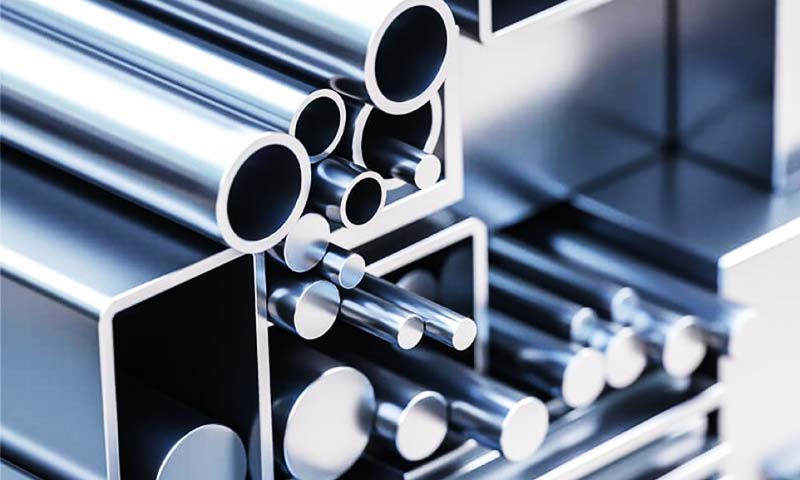
Aluminium alloys are a key choice in mechanical engineering thanks to their light weight, strength and versatility. This guide looks at the main types of aluminium alloy used in machining, explained clearly for technicians, operators and companies. The aim is to explain where specific series (2000, 5000, 6000, 7000…) are used and help you decide which materials suit each type of machining.
Classification of aluminium alloys
1000 series – Pure aluminium
These alloys (≥ 99% aluminium) offer excellent thermal and electrical conductivity and high corrosion resistance. They are often used for chemical plant components or heat exchangers that do not require high mechanical properties.
2000 series – Aluminium-copper (Avional)
Alloys such as 2017 and 2024 contain copper and are known for their high mechanical performance, making them ideal for aerospace and automotive applications. They require heat treatment to increase strength, but their weldability is limited.
3000 series – Aluminium-manganese
Good mechanical and corrosion resistance, but limited ductility. Suitable for heat exchangers and non-critical industrial components.
4000 series – Aluminium-silicon
Characterised by excellent castability and weldability, often used for brazing and welding.
5000 series – Aluminium-magnesium (Peraluman)
High corrosion resistance (especially in marine environments), good ductility and weldability without heat treatment. Ideal for pipework, pressure vessels and aluminium bodywork.
6000 series – Aluminium-silicon-magnesium (Anticorodal)
Excellent machinability, weldability and workability: widely used for extruded profiles, window frames, bicycle frames and welded structures. After heat treatment they offer intermediate mechanical strength.
7000 series – Aluminium-zinc-magnesium (Ergal)
7075 alloys (Ergal), with or without copper, are among the strongest, with tensile strengths of up to around 570 MPa. They are used in aerospace, racing components (cars, motorbikes, bicycles), fasteners and highly stressed parts. Limited weldability and higher cost are offset by high mechanical performance.
Applications in machining
CNC cutting, milling and turning
6000 and 7000 series alloys are preferred for machined components: high precision, good surface finish and resistance to distortion during machining.
Casting and die casting
The 4000 series (Silumin) is ideal for cast components thanks to its excellent castability and low shrinkage. Al-Si-Mg-Cu alloys such as A356/C355 are common in cast engine blocks and structural parts.
Structural assemblies and welding
The 5000 and 6000 series allow high-quality welds and stable alloys, and are used for welded structures, frames and durable architectural window frames.
How to choose the right alloy
– Mechanical strength: choose the 7000 or 2000 series for demanding structural applications.
– Corrosion: the 5000 and 6000 series offer greater protection in aggressive environments.
– CNC machinability: the 6000 series for finish and precision.
– Cost and availability: the 6000 series offers the best balance of performance and cost, while the 7000 series is more expensive.
Main advantages of aluminium alloys in engineering
– Low density (≈ 2.7 g/cm³) and an excellent strength-to-weight ratio compared with steel.
– Excellent thermal and electrical conductivity, useful in heat exchangers and electronic components.
– High resistance to atmospheric corrosion, which can be improved with anodising or protective coatings.
In short, understanding the types of aluminium alloy and their applications in machining is crucial for choosing the right material for your project. If you would like advice on which alloy to choose for CNC machining, industrial production or structural components, see our materials or contact us directly for technical support.