
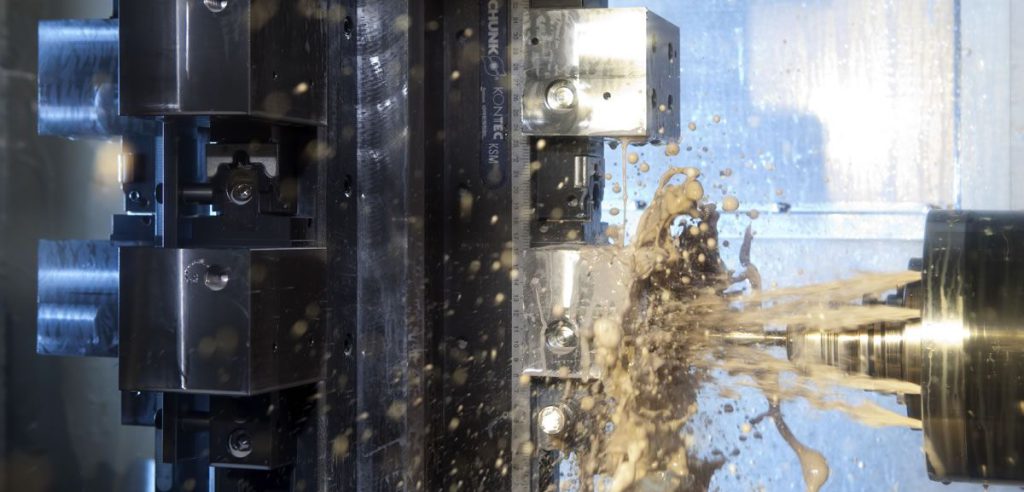
Brass is one of the many materials machined on precision CNC machines. Let’s look at its properties.
Brass is an alloy of copper (Cu) and zinc (Zn), possibly with other elements. Brasses made only of copper and zinc are called binary; those containing one further element are ternary, and those with a fourth element that characterises the alloy are quaternary.
Binary brasses with a zinc content below about 36% are known as alpha brasses. They have excellent cold workability (deep drawing and pressing) and fair hot workability. Alloys with more than 45% zinc have no practical use.
Binary copper-zinc alloys are normally machined on numerically controlled machines – precision CNC machines – but their toughness produces very long chips. To solve this, lead is added: it does not dissolve in the alloy and, because of its lower melting point, is the last element to solidify. It therefore ends up distributed at the grain boundaries of the copper-zinc alloy, making chips very short or even powdery and protecting the precision CNC machines.
Leaded brasses, also called free-cutting brasses, are used for turned parts such as valves and taps. CuZn39Pb3 in particular is used for gears, pinions and all complex parts that require high-speed machining with chip removal.