
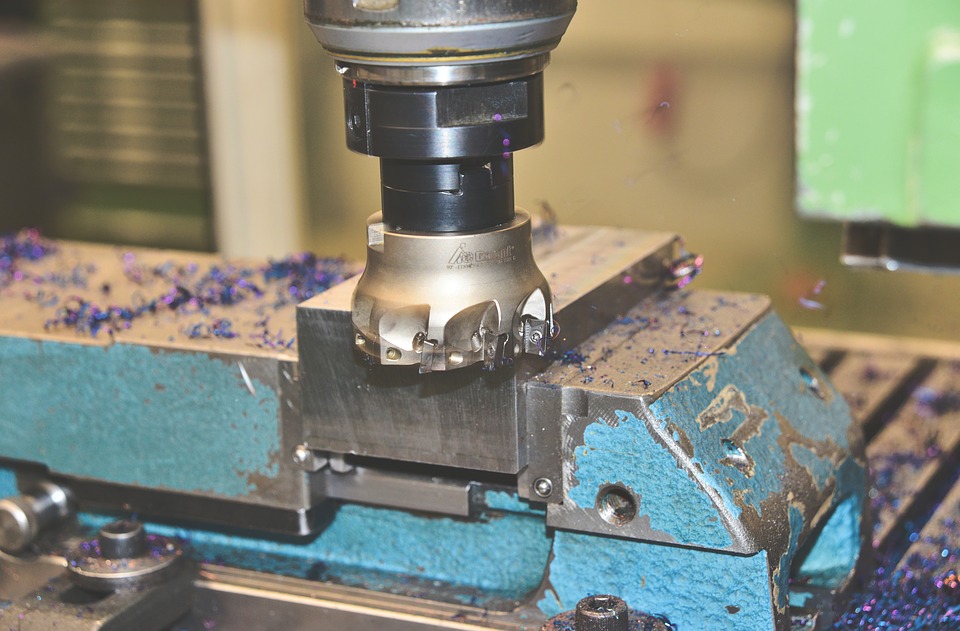
Milling is carried out with a specific machine: the milling machine. It is made up of several elements: a base and table, where the workpiece is clamped, and a column carrying the spindle, driven by an electric motor. The resulting rotation of the cutter removes material in the form of chips.
A milling machine can produce a wide range of surfaces: it is perfect for producing mechanical components, which is done in several passes. These include roughing and finishing: roughing removes a large amount of material quickly and economically, while finishing gives a part that matches the design in terms of dimensions and surface roughness.
There are two types of milling machine: horizontal and vertical. The former have a horizontally mounted spindle, while the latter have a vertically oriented cutter. With this machine, parts can be made to very high precision standards, as we will see below.
Precision machining: milling is ideal
A milling machine can also be numerically controlled: an electronic and IT technology that lets the machine work almost entirely on its own, with very high standards of precision and repeatability. An operator is still essential, entering the instructions into the computer that controls the machine: these define the geometry of the part and the tool path.
The machine then works on its own and the operator steps in only in case of faults or malfunctions – in short, they make sure the job runs correctly. The result is machining with precision down to a micron.