
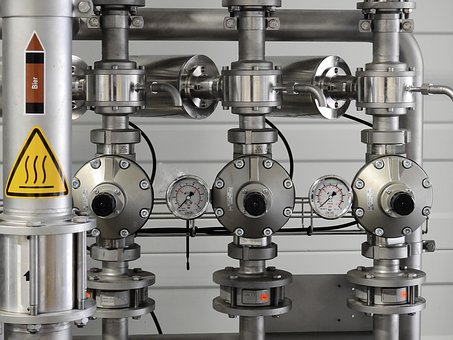
Like other areas of technology, hydraulics is both ancient and modern: the water wheel is so old that it predates written history, while the use of pressurised fluids to transmit and control movement developed mainly after the 1950s. Modern technology has found in fluid power a formidable aid in solving almost all automation, servo-control and regulation problems.
Hydraulic valves are proof of this. They are among the most widely used components not only in hydraulics, but also in industrial and civil plant engineering, because they shut off and regulate the flow of a fluid in a piping system. The simplest example of a valve is your kitchen tap, which regulates the water outlet pressure when operated. Fluid control is one of the most important functions in a hydraulic system. If the valves are chosen wrongly, the whole system will be compromised.
Types of hydraulic valve
Hydraulic valves must therefore be chosen according to their function. Here is a simple summary of the main types to help you choose the right one:
Pressure control valves limit pressure and protect the circuit from overpressure:
- Relief (maximum pressure) valves
- Sequence valves
- Unloading valves
- Pressure-reducing valves
- Counterbalance valves
- Pressure switches and transducers
Directional control valves direct the flow of fluid (often oil) to the cylinder or motor to produce movement in the required direction, to start or stop the actuator, or to speed it up or slow it down:
- Spool, in which a moving slide runs in a cylindrical bore in the valve body
- Poppet, in which a moving element seals against a cone
- Ball, in which sealing is provided by a ball.
Flow control valves regulate and control the speed of the actuator and its load:
- Bidirectional or unidirectional throttles
- Pressure-compensated flow regulators
This category also includes valves that block or allow the passage of fluid:
- Check (non-return) valves
- Shuttle (T-selector) valves
- Deceleration valves