
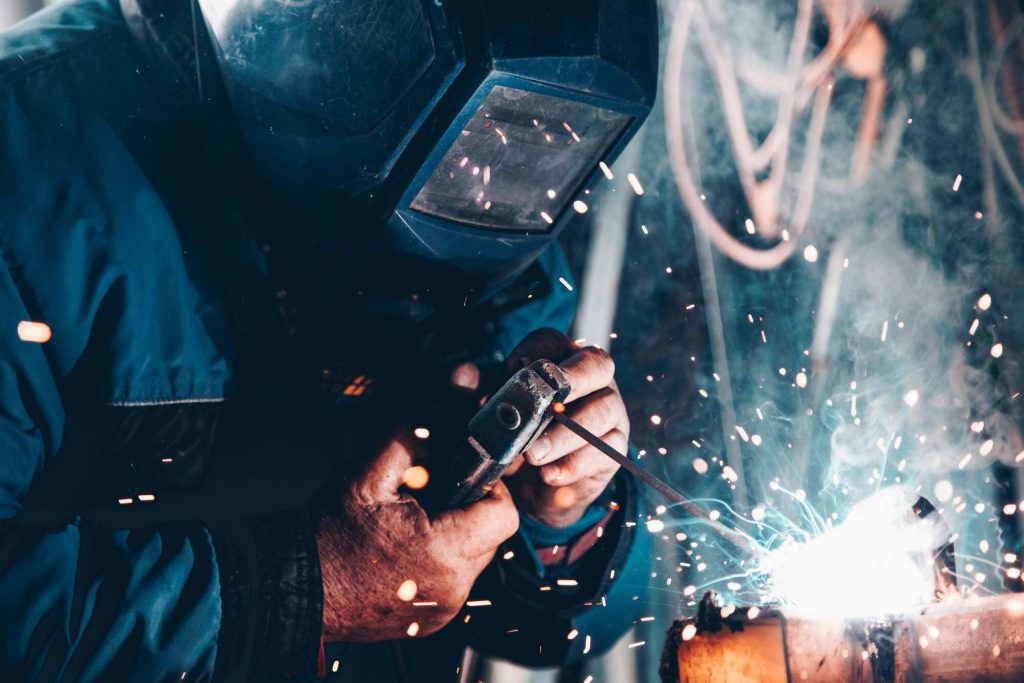
TIG, Tungsten Inert Gas, is a type of welding carried out with a non-consumable tungsten electrode shielded by an inert gas. TIG welding is typically used on materials such as stainless steel and is a very effective, high-quality process.
It is even more effective on light materials such as aluminium, which require particularly strong welds and often fail with other methods because of aluminium’s low melting point.
That said, this type of welding necessarily requires competent, specialised staff.
TIG welding: what you need
For optimal TIG welding on stainless steel, the following are essential: a power source, a torch, an inert gas cylinder and a filler metal rod, typically used in TIG welding.
TIG welding can be carried out in different ways:
- manual, where the electrode and arc length are controlled by the welder;
- semi-automatic, where the electrode and arc length are controlled by the welding machine while the welder moves the electrode;
- automatic, where all operations are handled by the welding machine.
How does a TIG welder work?
The inert shielding gas flows to the electrode over the weld pool through a ceramic nozzle. The torch moves along the joint, moving the weld pool with it. This keeps the electrode close to the material at a stable distance. When the electrode is brought to the melting point by the torch, the operator can carry out TIG welding safely.
The advantages of TIG welding, especially on materials such as stainless steel, are many: it can easily be automated, it allows safe and comfortable work and it gives operators a very high-quality final result.