
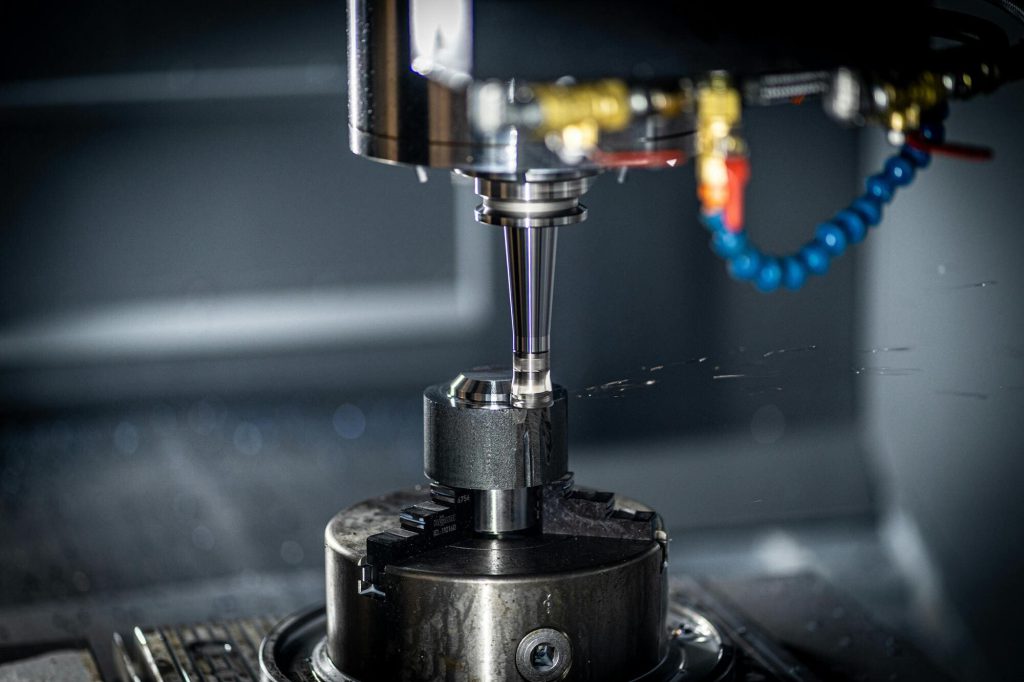
Electrical discharge machining (EDM) is one of the most advanced and highly regarded precision machining technologies in precision engineering. Thanks to its ability to shape hard, tough materials to extremely tight tolerances, it makes complex, detailed mechanical parts possible. Ideal for applications requiring high precision, EDM uses the combined action of heat and electricity to remove tiny amounts of material without putting pressure on the workpiece, giving excellent results even on complex geometries and delicate surfaces.
How EDM works
Electrical discharge machining combines heat and electricity to remove particles of metal with extreme precision. The process requires specific conditions to be carried out effectively.
Two key elements are needed to start the process:
- An electrode – made of graphite or copper, it must be highly resistant to electrical discharges and wear. During the process it is supplied with an ignition voltage of between 20 and 100 volts, with positive polarity, and positioned about 25 µm from the workpiece (the spark gap).
- A dielectric fluid – usually a light oil, it insulates the workpiece until ionisation, when it starts to conduct electricity.
The EDM process begins by immersing the workpiece in the dielectric fluid and supplying it with negative polarity. As the voltage increases, electrons are released from the cathode and strike the atoms of the dielectric, generating both positive and negative ions. This ionises the fluid, which changes from insulator to conductor. Once ionised, the dielectric fluid turns into plasma, an incandescent substance made of atoms and free electrons. Electrical discharges cross the fluid at regular intervals, with pauses of 1 to 30 microseconds. Each discharge generates enough heat to melt and vaporise tiny amounts of material on the workpiece. This repeated effect creates a series of minute craters on the surface, progressively removing material. The result is precision erosion, with no chips as in conventional machining, but with the formation of gas and tiny metal spheres.
Types of EDM
The same principle can be applied in two ways, chosen according to the result required and the characteristics of the workpiece. In wire EDM, the erosion process is unchanged, but the electrode is a tensioned conductive wire that cuts through the workpiece. This allows work on parts requiring a high degree of precision, achieving surface finishes down to Ra 0.04.
In sinker (die-sinking) EDM, the shape of the electrode is reproduced in the workpiece, which takes on a complementary form. The electrode must therefore have a precisely defined shape, and creating an electrode with the right structure is essential. Otherwise, the process is the same.