
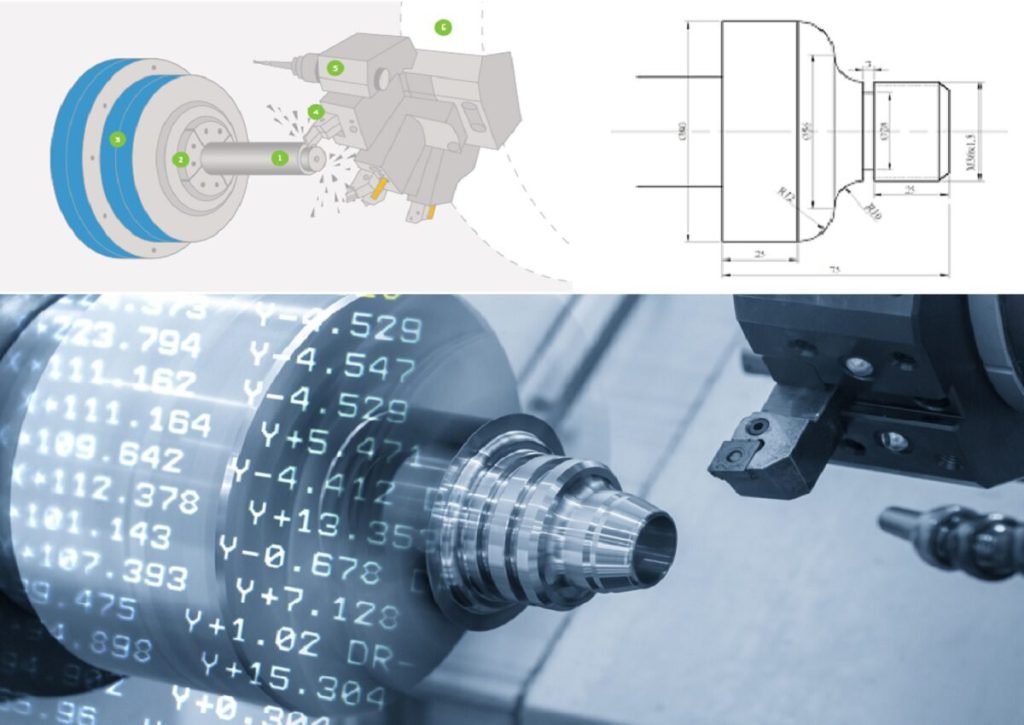
In today’s manufacturing market, speed can never come at the expense of precision. CNC (Computer Numerical Control) turning is the backbone of modern mechanical production, making it possible to produce complex components with a repeatability that manual machines simply cannot achieve.
However, not all CNC machining is the same. Improving production efficiency depends on how the technology is used.
Key factors for efficient CNC turning
-
Shorter set-up times
One of the biggest hidden costs in machining is machine downtime during changeovers. Modern CNC lathes with quick-change tooling and driven-tool turrets make it possible to switch from one part number to another in minimal time. This makes even small batches economically viable and gives the customer greater flexibility.
-
Combined machining (turning + milling)
Maximum efficiency is reached when the part leaves the machine finished, with no need for second operations on other machines. T.M.G.’s modern multi-axis turning centres can drill, tap and mill directly on the lathe.
The result: less material handling, fewer repositioning errors and faster delivery.
-
Advanced CAM programming
Efficiency starts in the technical office. Advanced CAM software optimises tool paths, reducing cycle times and insert wear while delivering excellent surface finishes without the need for subsequent grinding.
The role of the production partner
For a customer, improving efficiency means choosing the right supplier. A partner that continuously invests in its machinery (Industry 4.0) can offer a more competitive cost per part and a reliable delivery date.
At T.M.G., CNC turning is our core business. With state-of-the-art machinery and an experienced technical team, we turn technical drawings into high-precision components, optimising every second of the production process.