
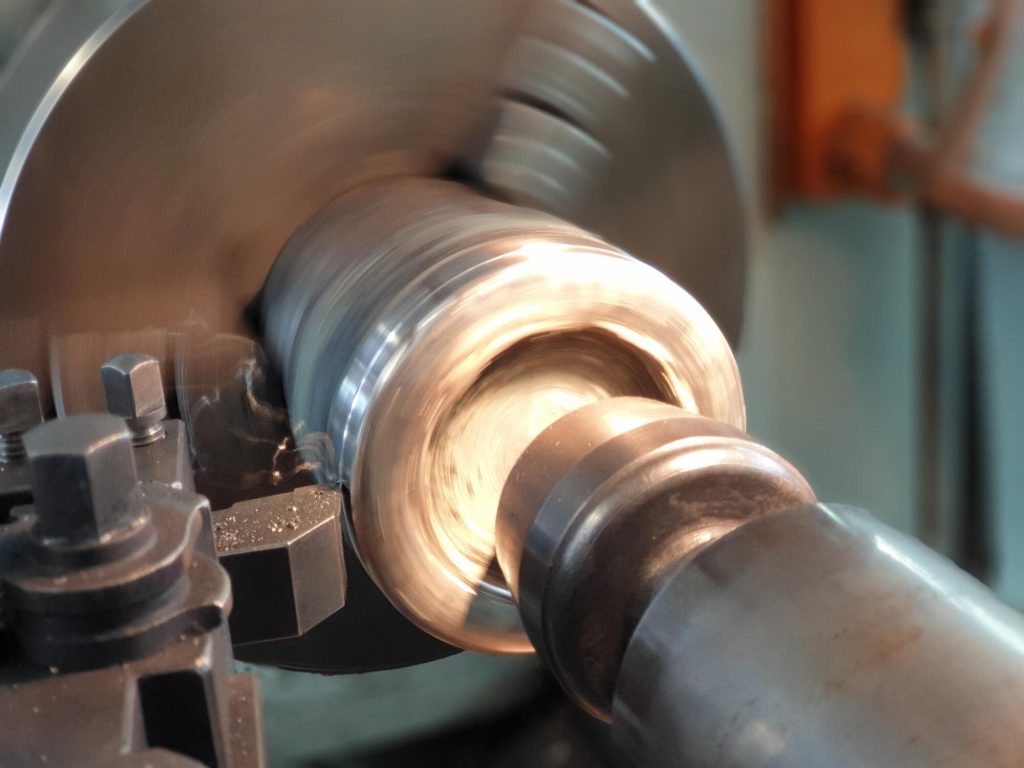
CNC lathes and conventional lathes share some basic similarities, especially in how the workpiece is machined. But because of the numerical control system, there are significant differences between them.
Compared with a conventional lathe, a CNC lathe has the following features:
- A CNC lathe uses a special guard that prevents chips or cutting fluid from escaping and injuring the operator.
- Unlike a conventional lathe, a CNC lathe has an automatic chip removal system. Its slant-bed layout and automatic conveyor make it easy to remove the chips produced during machining.
- On a CNC lathe the spindle speed is high and workpiece clamping is safe and reliable. CNC lathes mainly use hydraulic chucks, which simplify the operator’s work. With a hydraulic chuck, the clamping force can be adjusted effortlessly and safely.
- Another important difference is automatic tool change. During machining, tools are changed automatically by a special rotating turret, allowing the production process to be completed without interruption.
- On conventional lathes, the operator sets cutting and feed parameters to create the finished part, checking the result afterwards. These operations are repeated manually for every part. On a CNC lathe, however, the lathe operator only has to enter the machining parameters in the machine’s specific programming language, and the tools work automatically through every stage until the finished part is obtained with the exact characteristics required and an infinitesimal margin of error. The machine repeats the production parameters for each part without interruption until the required quantity is reached. As a result, production speed and accuracy are far higher than on a conventional lathe.