
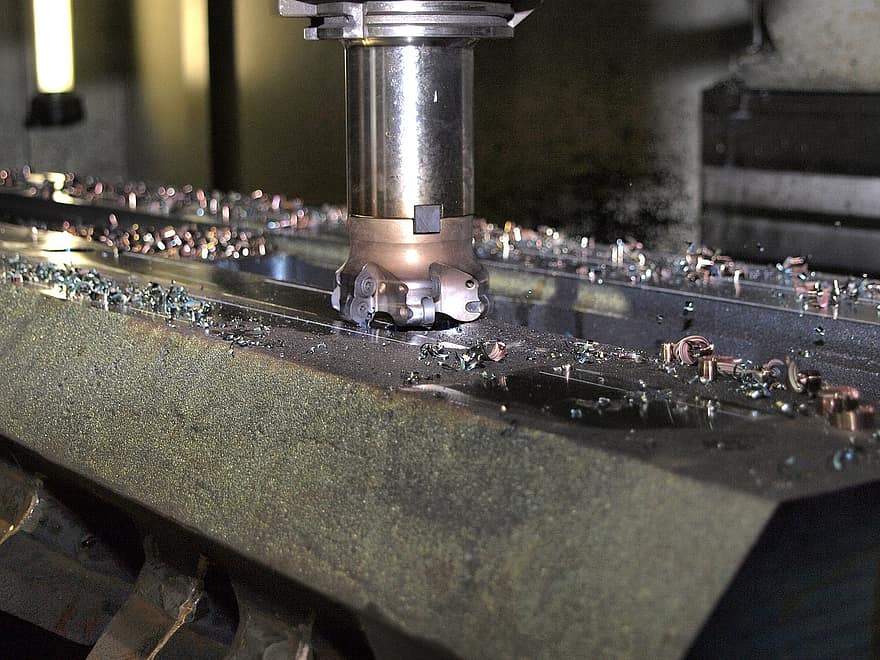
Milling is a type of CNC machining used in many situations, for operations such as end milling, chamfer milling and face milling. It can also be used as an alternative to drilling, countersinking and threading. In this way, milling can produce blind holes, through holes, threads and cavities on a wide range of surfaces.
Specifically, milling removes metal chips through the rotation of a tool with multiple cutting edges. This CNC machining is usually used to create particularly complex, non-symmetrical shapes. A milling cutter can produce holes, slots, pockets, grooves or three-dimensional profiles, depending of course on the type of cutter used.
There are many types of milling cutter, with different geometries, depending on the operation:
- Helical cutters
- Staggered-tooth cutters
- Double-angle cutters
- Plain cutters
- End mills
- Chamfer cutters
- Face mills
The CNC milling cutter is mainly used in the production of small batches, prototypes or custom-designed parts. It is also used to make tools for other processes, such as three-dimensional moulds. The high precision of milling means it can also be used on semi-finished parts produced by other processes, adding high-precision features to a part that has already been machined.