
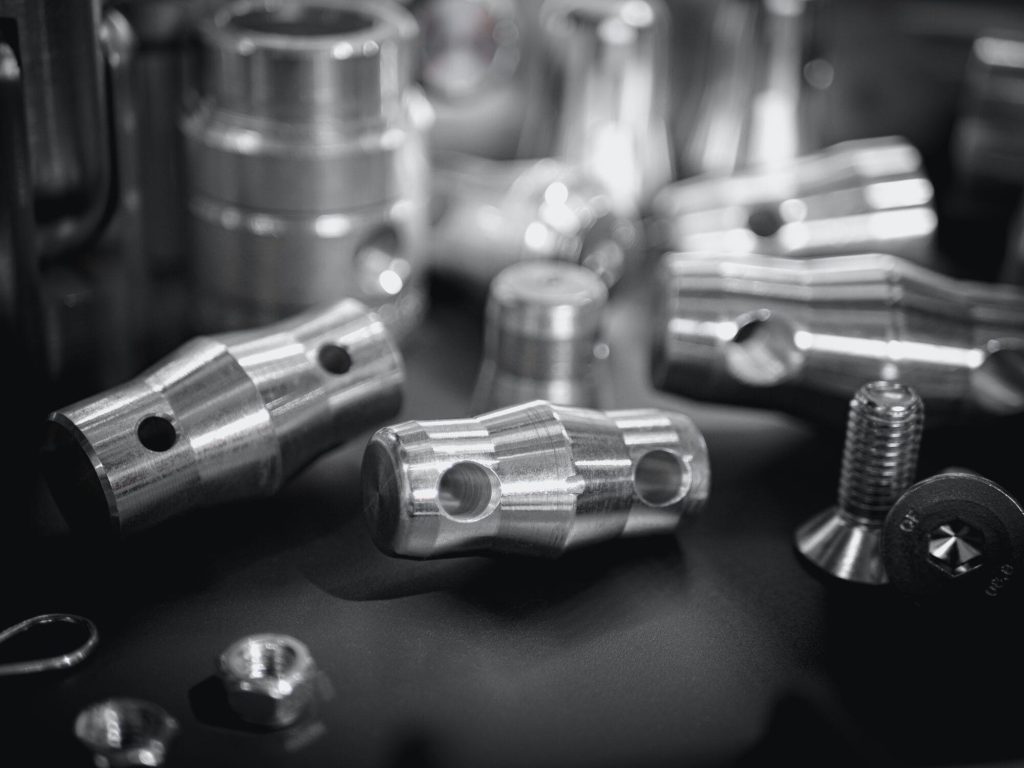
Aluminium alloys are among the most widely used materials in precision engineering for high-quality mechanical components. In this article we explore how aluminium alloys are chosen and their mechanical properties. When selecting materials for precision engineering, the choice cannot be reduced to steel alone. Some materials perform better in certain contexts, such as aluminium or, more precisely, aluminium alloys.
Properties of aluminium and its usefulness in precision engineering
Aluminium is a light, strong metal with a density of 2.70 kg/dm³. Its typical colour is due to oxidation, which prevents corrosion. It is malleable, weldable and has high electrical and thermal conductivity. Compared with steel, aluminium has a lower yield strength, but thanks to its lower density it can achieve high strength without adding weight. Its ability to combine with other elements allows aluminium alloys with different properties to be produced.
The main aluminium alloys
Aluminium alloys, or light alloys, combine aluminium with another element such as copper, manganese, silicon, zinc or magnesium. Each alloy has specific properties, but some advantages are common to all: low density, high ductility, excellent electrical and thermal conductivity, a low melting point and corrosion resistance that can be improved with treatments.
Aluminium alloys are divided into series according to their composition. The 1000 series is mainly pure aluminium and offers good conductivity, corrosion resistance and workability. The 2000 series, also known as Duralumin or Avional, is light and hard and can be heat-treated to increase mechanical strength. The 3000 series combines aluminium and manganese, offering high mechanical strength but poor ductility. 4000-series alloys contain aluminium and silicon, giving them wear resistance. The 5000 series, called Peraluman, combines aluminium and magnesium and offers ductility, weldability and resistance to melting and corrosion. The 6000 series, called Anticorodal, combines aluminium, silicon and magnesium and offers machinability, weldability, mechanical strength and corrosion resistance. Finally, the 7000 series, known as Ergal, combines aluminium, zinc and magnesium and is light, machinable and resistant to load and corrosion, though it has poor weldability.
The choice of alloy depends on the mechanical properties required and the specific application. For example, 99% pure aluminium alloys are ideal for heat exchangers and chemical plants. For precision components in aviation and aerospace, Avional alloys are preferred for their strength-to-weight ratio. 3000-series alloys are commonly used in the food industry, while Peraluman is used in automotive and marine applications. 6000-series alloys are used for components in the cycling, motorcycle and rail sectors. Ergal, despite its poor weldability, can also be used in aerospace and aviation.
In conclusion, the choice of aluminium alloy depends on its mechanical properties and specific field of application. To obtain quality components in precision engineering, it is essential to carefully consider the characteristics of the different alloys available. See the aluminium alloys we machine.